expr:class='"loading" + data:blog.mobileClass'>

Friday, June 24, 2016

West Virginia floods


West Virginia floods: 7 people dead, including two kids

West Virginia Floods
In this photo released by the The Weather Channel, a vehicle rests on the in a stream after a heavy rain near White Sulphur Springs, W.Va., Friday, June 24, 2016.

CHARLESTON, W.Va. - A storm system dumped up to 9 inches of rain on parts of West Virginia, trapping 500 people in a shopping center when a bridge washed out, while dozens of other people had to be plucked off rooftops or rescued as water quickly rose during the deluge.

At least seven people died, including an 8-year-old boy who was swept away by swift-moving creek water, and a 4-year-old boy who was caught in rushing waters in a different county, authorities and Gov. Earl Ray Tomblin's spokesman said Friday. The rains submerged homes and cars in dirty brown water and chewed up roads. Tens of thousands of people were without power at the peak of the storm.

Some areas are "probably looking at flooding that's going to be the worst in 100 years," Tomblin's spokesman Chris Stadelman said.

Forty-four of West Virginia's 55 counties are under a state of emergency, and parts of the mid-Atlantic region face more severe weather Friday, reports CBS News correspondent Kris Van Cleave.
Eric Blackshire was one of the hundreds of people stranded at the Crossings Mall, a mix of restaurants, retail and grocery stores and a hotel in Elkview, which is about 15 miles northeast of Charleston. The people were trapped when the culvert bridge washed out Thursday, Kanawha County Sheriff's Sgt. B.D. Humphreys said.

Some people had to sleep in their cars or at businesses overnight, and restaurants stayed open to help feed people, WSAZ reported.

Blackshire opted for a room at the hotel.

"It was kind of like a hurricane party. I guess you could call it a flood party. There were lots of beers being drank last night," he told The Associated Press.

He was able to get across Friday when the Pinch Volunteer Fire Department firefighters used a strong rope to guide people down a hillside. About 50 people had been rescued so far.

As for a better solution to get more people to safety, Kanawha County Sheriff's Office spokesman Sgt. Brian Humphreys said: "that's going to require, I think, some engineering efforts" - perhaps a temporary bridge.

"I'm screwed," Blackshire said. "I mean I've only got one vehicle and it's over there now and it's gonna be days before it gets out."

An area near the West Virginia-Virginia border received at least 9 inches of rain while other parts of the state had 3 to 5 inches, National Weather Service hydrologist John Sikora said. While most of the rain had tapered off Friday, there were still scattered showers, thunderstorms and river flood warnings.

Kanawha County emergency officials said there were at least 70 water rescues.

"We had swift water rescue teams out until late last night and back out again this morning literally rescuing people from rooftops and upper stories of houses," Stadelman said.

For hours, Paul Moya was trapped on top of a roof. A diabetic in need of medical attention, he watched as his daughter's home was washed away and shot a video as he waited for rescue.

"I'm still shaking. I really just want to break down and cry right now," Moya said, speaking from his hospital bed. "All I could see was the homes burning and the electrical poles burning. I think I could say that now I was scared."

The heaviest rainfall was in Greenbrier County. At The Greenbrier, a luxury resort nestled in the mountains, the golf course was overrun by rushing waters. The course is scheduled to host a PGA tour event, The Greenbrier Classic, from July 4-10.

"It's like nothing I've seen," owner Jim Justice said in a statement. "But our focus right now isn't on the property, golf course or anything else. We're praying for the people and doing everything we can to get them the help they need."

Professional golfer Bubba Watson was apparently visiting the resort and tweeted photos of entire holes underwater:

The governor issued a state of emergency on Thursday for 44 counties in the state.

"I have authorized the deployment of up to 150 members of the West Virginia National Guard to assist local emergency responders as we continue to evaluate the situation today," he said in a statement Friday.

Three people died in Kanawha County; the fourth death was an 8-year-old boy in Wheeling, the governor's spokesman said.

The body of Emanual Williams - known as "Manny" - was recovered after he fell into Big Wheeling Creek on Thursday, said Harry Croft, pastor at Marwin Church of the Nazarene at Wheeling.

Croft said the mother told him that she was walking across the creek with her son and daughter because Manny wanted to catch crawdads. One of the children slipped and the mother grabbed both the boy and his sister in the swift current.

"She lost her grip on Manny," the pastor said.

The boy's body was found about a half-mile from where the family lives, Croft said.

Croft said he informed the boy's mother that her son's body had been found.

"I said, 'They found Manny,'" he said. "And I said, 'I can tell you this, he's with Jesus now.' That's the only thing I knew to tell her."

The fifth victim, the 4-year-old boy, was with his grandfather when he fell into the creek, which usually runs about an ankle deep, said Bob Bibbee of the Ravenswood Fire Department, which confirmed the boy was found dead at 11:30 a.m. about a quarter mile from where he fell.

The grandfather jumped in after the boy to try to pull him out but the water was rushing too quickly. Neighbors, alerted by the sound of the family's screams, tried to help save the boy but were also unable to reach him.

The bodies of two other males were found amid debris near White Sulphur Springs in Greenbrier County.

Across the state line, Virginia Gov. Terry McAuliffe declared a state of emergency in Alleghany County and Covington after severe weather and flooding there.

Three emergency workers were injured during a water rescue in Alleghany County, officials said. One worker fell in the water during a rescue and two others were hurt while rescuing their colleague, Botetourt County Battalion Chief Andrew Moore said Friday.


source: cbsnews

Thursday, June 23, 2016

Powerful Tornado Strikes East China


Powerful Tornado Strikes East China; 78 Reportedly Dead

BEIJING — A powerful tornado and hailstorm struck the outskirts of an eastern Chinese city on Thursday, killing at least 78 people and destroying buildings, smashing trees and flipping vehicles on their roofs.

The tornado hit a densely populated area of farms and factories near the city of Yancheng in Jiangsu province, about 800 kilometers (500 miles) south of Beijing.

Nearly 500 of people were injured, 200 of them critically, the official Xinhua News Agency reported. Roads were blocked with trees, downed power lines and other debris, while heavy rain and the possibility of further hailstorms and even more tornados was complicating rescue efforts, state broadcaster CCTV reported.

The disaster has been declared a national-level emergency, and on a trip to Uzbekistan, Chinese President Xi Jinping ordered central government bodies to provide all necessary assistance.

Tents and other emergency supplies were already being sent from Beijing, CCTV said.

The network showed people carrying the injured to hospitals, cars and trucks lying upside down, street light poles snapped in half, and steel electricity pylons crumpled and lying on their side. Power and telephone communications were knocked out over a broad area.

"I heard the gales and ran upstairs to shut the windows," Xinhua quoted area resident Xie Litian, 62, as saying. "I had hardly reached the top of the stairs when I heard a boom and saw the entire wall with the windows on it torn away."

The roof then collapsed as he raced downstairs, Xie said. After sheltering in a corner for 20 minutes, he emerged to find the neighborhood transformed into a wasteland. "It was like the end of the world," he said.

Jiangsu is a coastal province north of Shanghai. Yancheng is an ancient city with more than 8 million people.

The Jiangsu provincial fire and rescue service provided no word on casualties but said on its microblog that the storm was accompanied by hail. Crews were dispatched to evacuate workers and secure chemicals and other potentially dangerous items at a sprawling solar panel factory in the Yancheng suburb of Funing, it said. No chemical leaks been reported, CCTV said.

Photos posted online showed a wrecked three-story schoolhouse with large trees strewn on its playing field. Its windows had been blown out and its roof and upper floor torn off, along with those of numerous other buildings.

Bodies were shown lying in the open or buried in rubble. At least one hog farm was hit, its livestock covered in bricks and roofing material.

The reports said the tornado struck at about around 2:30 p.m. and hit Funing and Sheyang counties on the city's outskirts the hardest, with winds of up to 125 kilometers per hour (78 mph).

Tornados occasionally strike southern China during the summer months, but rarely with the scale of death and damage caused by the one on Thursday.

This year, southern and eastern China have experienced weeks of torrential rain and storms that have caused widespread flooding and dozens of casualties.

The southern part of the country is hit every year during the May-July monsoon season, but this rainy season has been particularly wet. Water levels in some major rivers have exceeded those of 1998, when China was hit by disastrous floods that affected 180 million people, according to state media reports.


source: nytimes

Friday, June 17, 2016

Local Emergency Declared in 4,000-Acre Santa Barbara County Wildfire


Local Emergency Declared in 4,000-Acre Santa Barbara County Wildfire.

Santa Barbara County firefighters
Santa Barbara County firefighters stand by for structure protection as the Scherpa Fire consumes heavy brush near Highway 101 on July 16, 2016. (Credit: Brian van der Brug / Los Angeles Times)

A wildfire that burned thousands of acres in Santa Barbara County prompted the declaration of a local emergency as firefighters continued Friday to face difficult conditions.
More than 1,200 personnel were responding to the fire, which has been burning since it started near Refugio Road, west of Goleta, on Wednesday.

The fire had scorched 4,000 acres and was just 5 percent contained, officials stated at a later-morning news conference Friday. About 270 structures are threatened.

A water treatment plant that serves El Capitan State Beach was burned down overnight, a California State Parks superintendent said. Camping reservations were likely to be canceled, he said.

A declaration of local emergency was made by the county just after 10 a.m., said Supervisor Doreen Farr, who represents the area burning. Agriculture and natural resources have been damaged, she said. Another official said avocados, olives, lemons and cattle-grazing lands were damaged.

The fire comes as California continues into its fifth year of drought.

“It is ominous. We are concerned because the fuels out there are drought-stressed. There’s a lot of tree mortality out there that makes fire behavior worse,” Santa Barbara County Fire Department Chief Eric Peterson said. "The drought is making an already pretty volatile situation not any better."

County Sheriff Bill Brown warned residents to continue to heed mandatory evacuation orders and to be prepared to leave at a moment's notice in areas where evacuation warnings are in effect.

"This is still a very dynamic fire situation and we do not want residents ... to be complacent," Brown said. "Even though conditions may appear to have become better during the day, the reality is things can change ... very rapidly in the evening. We do not want our residents to have a false sense of security."

Officials estimated the fire, is expected to be contained sometime in the afternoon of Wednesday, June 22, the federal InciWeb page for the wildfire stated Friday morning. That statement was no longer on the site by midday.

Information about the fire, which is being referred to as both the Scherpa Fireand Sherpa Fire, is also available on the county's website.

Gusty sundowner winds have continued to fan the flames, pushing them down the mountain toward the coast, during the overnight hours. The winds once again forced the closure of the 101 Freeway through the region Thursday night.

Officials were able to reopen the Freeway about 4 a.m. Friday.
A helicopter drops water

Sundowner winds were expected to continue to be a challenge for firefighters as forecasters have predicted them to return each afternoon through the weekend.

A heat wave was also expected to hit the region over the weekend. Temperatures will rise into the 80s and 90s and humidity will drop, and sundowners are expected to again pick up about 5 p.m., National Weather Service Warning Coordination Meteorologist Eric Boldt said.

The heat wave will peak and humidity will plummet on Monday, Boldt said.

Fire restrictions were in effect in Los Padres National Forest.

Air-quality warnings were in effect for the southern areas of Santa Barbara County through the weekend, unless conditions change, officials said.

Crews have successfully protected residential property in the El Capitan Canyon Area and El Capitan State Beach, according to the Inciweb site.

Mandatory evacuations were in place for areas of Refugio Canyon, Las Flores, Venadito, El Capitan Campground, El Capitan Canyon, El Capitan Ranch and Refugio Campground. About 400 phone lines received emergency evacuation notifications, Sheriff Brown said.

An evacuation warning was issue from El Capitan Canyon to Farren Road.

An evacuation center was set up at the Wake Center, located at 300 North Turnpike Road in Goleta, and Santa Ynez Union High School, according to the InciWeb page. Large animals can be taken to the Earl Warren Show Grounds.

The fire was being managed by the U.S. Forest Service, Santa Barbara County Fire Department and Cal Fire.

The cause of the fire was under investigation.

source: ktla

Thursday, June 16, 2016

Wildfire near California oil refinery burning out of control


Wildfire near California oil refinery burning out of control

Wildfire,California
This photo provided by Los Padres Forest Aviation and KEYT-TV shows a wildfire burning in Los Padres National Forest, north of Santa Barbara, on Wednesday, June 15, 2016, in Goleta, Calif.

GOLETA, Calif. (AP) — A California wildfire spurred by strong gusts mushroomed in size and burned out of control Thursday in a remote coastal area west of Santa Barbara, forcing the evacuation of hundreds of campers, some homes and an oil refinery as it crept toward the ocean.

Winds and rising temperatures across the dry Western U.S. also worsened wildfires in other states. A blaze in central New Mexico grew to more than 3 square miles and forced residents to flee at least 50 homes after sending up a towering plume of smoke that blanketed the state's largest city in a thick haze.

Friday, June 10, 2016

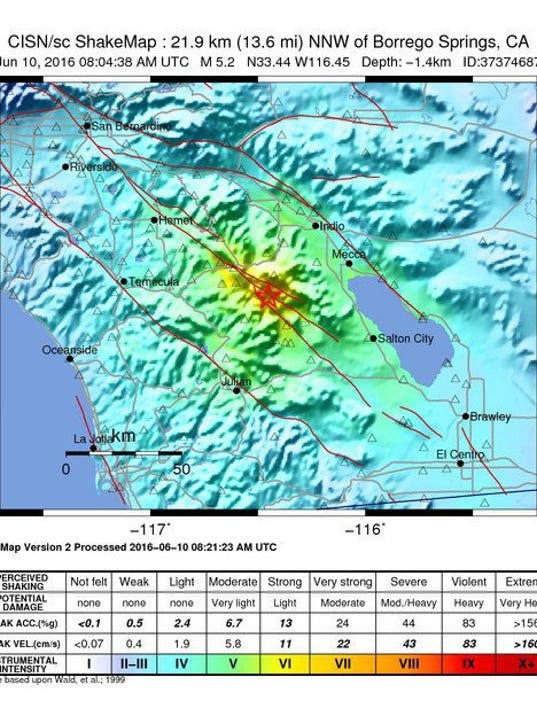
Southern California rocked by 5.2 earthquake


Southern California rocked by 5.2 earthquake

A handout shakemap released by the US Geological Survey (USGS)(Photo: USGS, EPA)

LOS ANGELES -- An moderate earthquake with a preliminary magnitude of 5.2 rocked Southern California, rousing residents out of bed at about 1:05 a.m. PT.

The quake was centered near Borrego Springs in the desert east of Los Angeles, the U.S. Geological Service reported.

On the west side of Los Angeles, about 100 miles from the epicenter, the quake produced a long shaking motion lasting about 30 seconds. There was no hard jolt. In USA TODAY's news bureau on the ninth floor of an office building near Los Angeles International Airport, window shutters shook and the building structure rolled in steady waves.

The quake was also felt in San Diego.

Seismologist Lucy Jones tweeted that quake struck on the San Jacinto fault, one of the most active in the region. She says the same fault produced a magnitude 6 earthquake in 1937 and a 5.3 quake in 1980.

source: usatoday

Tuesday, June 7, 2016

Tropical Storm Warnings


Tropical Storm Warnings Dropped on Part of Coast.

Tropical Storm Colin continues to move away from the southeastern coast of the United States, but not before dumping heavy rain along North Carolina's Outer Banks.

The National Weather Service dropped a tropical storm warning for northern Georgia, South Carolina and the southeastern coast of North Carolina at 8 a.m. Tuesday.

But the warning continues in part of North Carolina, from just north of Wilmington to Oregon Inlet, which is just south of Nags Head on the Outer Banks.

Forecasters say up to another 3 inches of rain could fall along the Outer Banks. Wind gusts of up to 50 mph are still possible.

Schools in Wilmington were opening two hours later than usual.

Duke Energy reported just a handful of customers without service in eastern North Carolina.

Some cities in Florida got 9 inches of rain during Tropical Storm Colin.

The National Weather Service said Tuesday that parts of Pinellas County, along Florida's Gulf Coast, got that much rain. Other areas, from Levy to Sarasota counties, were also soaked with 1 to 6 inches of rain in a 24-hour period.

Flood warnings were issued in many parts of the Tampa Bay area and Tuesday's commute was shaping up to be a difficult one with roads underwater and in some areas, closed entirely. Rain fell steadily in the Tampa-St. Petersburg area overnight.

Storms are expected to continue through the afternoon.

Susie Morris, the proprietor of the Lighthouse Inn Bed & Breakfast on Georgia's Tybee Island, said she awoke Tuesday to no wind and no rain.

Morris said that to her relief, Tropical Storm Colin had not flooded the inn, a restored 1910 home.

The National Hurricane Center said Colin marked the earliest that a third named storm has ever formed in the Atlantic basin. Morris said she's not worried about the early start to the 2016 hurricane season, but will continue to listen to weather reports and take precautions when needed.

Forecasters expect Tropical Storm Colin's forward progress to speed up during the day Tuesday as it chugs along the southeast coast, most likely just off shore.

Jack Beven, senior hurricane specialist at the National Hurricane Center, said the storm was moving at 31 mph early Tuesday morning, and was expected to move even faster later in the day.

Beven said the storm's track will be roughly parallel to the U.S. coast as it moves northeast near the South Carolina and North Carolina coast.

Beven said there's a chance for 1 to 3 inches of rain in parts of the Carolinas.

Tropical Storm Colin seems to be bypassing South Carolina.

No rain was reported early Tuesday across the state, although earlier rain has brought the usual street flooding in downtown Charleston.

The National Weather Service still has a tropical storm warning in effect for the entire coast, although winds are expected to be only around 15 to 25 mph, with occasional gusts up to 35 mph. Forecasters say no additional rain is expected.

No injuries have been reported.

Transportation Department officials say parts of nine roads are closed, six in Charleston County and three in Jasper County.

South Carolina Electric & Gas reported 72 customers without service Tuesday morning. Jasper County had the biggest problem with about three dozen customers without service.

Duke Energy reported only a handful of customers without service.

Meanwhile, Jack Beven, a senior hurricane specialist, at the U.S. National Hurricane Center, says 1 to 3 inches of rain are possible along the coast of North Carolina.
The U.S. National Hurricane Center says Tropical Storm Colin's center is moving into the Atlantic east of the Georgia coast.

The storm's maximum sustained winds Tuesday morning are near 50 mph (85 kph). Some strengthening is expected, but the storm is forecast to lose its tropical cyclone status by Tuesday night.

As of 5 a.m. EDT, Colin was centered about 90 miles (145 kilometers) south-southwest of Charleston, South Carolina, and moving northeast near 31 mph (50 kph).

Colin is expected to produce 3 to 6 inches of rain across western to northern Florida, southeast Georgia and coast areas of the Carolinas through Tuesday. Isolated areas could see up to 10 inches.

Also, tornadoes will be a possibility across parts of the coastal Carolinas on Tuesday.
The National Weather Service says Tropical Storm Colin has made landfall and is bringing high winds and heavy rain to northern Florida.

The weather service says the center of the storm was located about 55 miles (90 kilometers) west-southwest of Jacksonville early Tuesday morning.

It says the storm's maximum sustained winds were around 50 mph (85 kph) with higher gusts and it is moving to the northeast at 23 mph (37 kph).

It is expected to continue moving in that direction at a faster speed over the next 48 hours.

Colin is expected to produce 3 to 6 inches of rain across western to northern Florida, southeast Georgia and coast areas of the Carolinas through Tuesday. Isolated areas could see up to 10 inches.

source: abcnews

Sunday, June 5, 2016

East Coast on alert as Tropical Storm Colin forms


East Coast on alert as Tropical Storm Colin forms, severe storm front moves through.

Much of Florida's western coast was placed under a tropical storm warning Sunday as Tropical Storm Colin formed in the Gulf of Mexico, as a separate storm system brought severe weather and damaging winds to the Mid-Atlantic region.

Colin is on course to hit Florida as soon as Monday, according to the National Hurricane Center, which warned the storm could cause serious flooding along much of the state's Gulf coast.

The center added the quickly moving storm is the earliest a third named storm has ever formed in the Atlantic basin.

The storm was moving at a speed of about 12 mph, and was expected to pick up the pace later Sunday.

"It's going to impact most of the state in some way," Gov. Rick Scott told the Associated Press. "Hopefully we won't have any significant issues here, but we can have some storm surge, some rain, tornados and some flooding."

Scott postponed a political meeting with presumptive Republican presidential nominee Donald Trump scheduled Monday in New York so he can remain in the state capital to monitor the weather.

Tropical storms carry wind speeds of between 39 mph and 73 mph.

Tropical Storm Colin is likely to bring dangerous rainfall levels, and residents were warned about possible flooding and hazardous driving conditions. Rain began falling in the Tampa Bay area just past noon on Sunday.

Scott warned residents not to simply look at the center of the storm, saying the heaviest rain will be to the east and west of it.

Several counties in the Tampa Bay area made sandbags available throughout the weekend for residents to prepare for potential flooding, Fox 13 reported.

"We're surrounded on three sides by water," said Pinellas County spokesman Nick Zoller, who said the county distributed 3,300 sand bags on Saturday, a number he expected to go up now that a tropical storm warning is in effect.

Just to the north, Pasco County Emergency Services Director Kevin Guthrie said the message is to be prepared.

"We are going to flood in parts of Pasco County," Guthrie said in an email.

After affecting the Gulf coast of Florida, the Colin is forecast to move northeast. The Georgia coast and the north Florida Atlantic coast were placed under a tropical storm watch Sunday evening.


Colin is the latest in a series of severe whether events across the country, from record-breaking heat in the West, flooding in Texas and storms that are expected to cause problems in the nation's capital and mid-Atlantic region.

The National Weather Service warned of an "enhanced" risk of severe storms in the mid-Atlantic region with the possibility of damaging winds.

Sterling, Virginia-based meteorologist Chris Strong said the primary threat in the Baltimore-Washington metropolitan area is from damaging wind gusts, and there's a lesser threat for tornados.

Wakefield, Virginia-based meteorologist Lyle Alexander says the threat on the Eastern Shore is from winds and more localized heavy rain.

The weather service warns that heavy rain in central Virginia and the Shenandoah Valley could mean flooding in areas that received rain Saturday. Flash flood watches are in effect until evening.

Mount Holly, New Jersey-based meteorologist Lance Franck says in Delaware the threat is from high winds and torrential downpours bringing flooding to urban areas and areas with poor drainage.

In New York City, the last day of a music festival that was to include performances by Kanye West and Death Cab for Cutie was canceled because of weather concerns.

The heavy rain that's been hovering over parts of Southeast and Central Texas and caused deadly flooding began to lift Saturday, but officials said the flooding emergency near the Gulf Coast was worsening and Army officials kept up their investigation of a training exercise that turned deadly at Fort Hood.

In Southeast Texas, water levels began to recede Saturday along upstream portions of the Brazos River, but the peril increased downstream as the water churned toward the Gulf of Mexico.

Emergency officials in Brazoria County warned residents in East Columbia, Bailey's Prairie and Bar-X to be prepared to evacuate their homes.

Except for widely scattered showers in Central and East Texas, the bulk of the rain Saturday was confined to the upper Texas Gulf Coast and the southern tip of Texas.

In Fort Bend County, just southwest of Houston, emergency officials reported seeing slightly improved conditions in flood-struck areas. And while the rain-swollen Brazos has ceased to rise, County Judge Robert Hebert said, some neighborhoods remain cut off by floodwaters and many local streets remain impassable.

source: foxnews

Thursday, June 2, 2016

Heavy Rains Cause Floods in France and Kill 9 in Germany


Heavy Rains Cause Floods in France and Kill 9 in Germany


PARIS — Torrential rains have caused major flooding in central and northeastern France this week, forcing the evacuation of thousands of people, some on boats or kayaks, and threatening priceless works of art stored in Paris’s most celebrated museums. In Germany, heavy rains claimed the lives of nine people.

In Paris, the Seine rose 16 feet above its typical level, flooding the lower embankments and shutting several roads but causing no significant damage. The level is still far from the record of 1910, however, when the river rose 26 feet above its regular level.

Nonetheless, the city authorities advised people to stay away from the banks of the river and part of Paris’s commuter train system that runs below ground along the Seine was shut as a preventive measure.

The Louvre announced that it would be closed on Friday to move, as a precautionary measure, works of art in areas vulnerable to flooding.

The Musée d’Orsay, in a former train station on the Left Bank near the Seine, closed early to put in place a flood-protection plan that calls for swift evacuation of the museum’s Impressionist masterpieces and other works of art in the event of flooding.

The rainfall also disrupted the French Open, where several tennis matches have been postponed.

Officials in France and Germany were bracing for even more rainfall this week. The Loing River, a tributary of the Seine, has risen to levels not seen since 1910, and the Île-de-France region, which includes Paris, got more rainfall last month than in any May since 1960.
Inundated streets in Simbach am Inn, southern Germany, on Thursday.

President François Hollande said Thursday that the rainfall and floods were “very serious,” and linked them to global warming.

“When there are climatic phenomena of this seriousness, we must all be aware that we must act globally,” he said. He later added that the government would declare a state of disaster for affected areas, enabling residents and businesses to receive special insurance compensation. About 20,000 homes in France had lost power and an estimated 5,000 people had to be evacuated.

Meteorologists attribute the recent deluge to a dip in the jestsream that has trapped low-pressure air over much of France and Germany, where the air is then warmed by the sun. This occurrence often leads to heat waves, and to thunderstorms as the hot air rises.

The recent thunderstorms have been more intense than usual because the hot air rises to encounter colder air in the upper atmosphere. Generally, the greater the difference between the rising hot air and the colder high air, the bigger the storms.

Forecasters say there could be a few more days of rain before the low-pressure air finally moves on.

Speaking from the government’s crisis center in Paris on Thursday, Prime Minister Manuel Valls said that the situation was still “tense” and “difficult” in certain areas.

More than 3,000 people were evacuated from Nemours, about 50 miles south of Paris, after the Loing overflowed, flooding businesses and homes. The surrounding Seine-et-Marne area was on high alert for floods on Thursday, and 12 other administrative departments in the Île-de-France and Centre-Val de Loire regions were on the second-highest level of flood alert.

Traffic around Orléans, about 75 miles south of Paris, was blocked, and on Tuesday, 217 inmates had to be evacuated from a prison near Orléans. The Château de Chambord, a landmark in the Loire Valley, about 30 miles southwest of Orléans, was surrounded by water.

In Germany, the rains have claimed nine lives.


On Monday, in the southwestern state of Baden-Württemberg, two people, including a firefighter, were sucked into a drainpipe in the town of Schwäbisch Gmünd; a 62-year-old man was found dead in a flooded basement garage in Weissbach; and a 13-year-old girl, seeking shelter under a railway bridge, was struck by a train and killed in Schorndorf.

On Thursday, five people were found dead in the southern German state of Bavaria. They included three women from one family, in a home in the town of Simbach am Inn; a 75-year-old man in the same town; and an 80-year-old woman in the neighboring village of Julbach.

Three others were missing, and the death toll could rise, Michael Emmer, a spokesman for the police in the Lower Bavaria region, told the German news agency DPA.

Interior Minister Joachim Herrmann said the intensity of the flooding had taken officials by surprise. “Within a few minutes, the water level rose about several meters,” he said.

Officials said they were preparing for additional storms and strong rains in western and southern Germany. At a news conference, Chancellor Angela Merkel expressed condolences to the families of the victims.

In the village of Bad Neuenahr-Ahrweiler in the state of Rhineland-Palatinate, the Ahr River rose nearly 13 feet to a level that officials said was unprecedented. Several campers in the region sought refuge on the roofs of vehicles and were rescued by helicopter.

In the nearby Eifel mountain range, which is popular with tourists and hikers, flooding was also reported.

Thousands of homes in Bavaria were without power, officials said.

source: nytimes

Wednesday, June 1, 2016

Extreme Weather May Raise


Extreme Weather May Raise Toxin Levels in Food, Scientists Warn

U.N. report says wheat and other crops generate potential toxins to protect themselves from intense weather


NAIROBI, May 31 (Thomson Reuters Foundation) - As they struggle to deal with more extreme weather, a range of food crops are generating more of chemical compounds that can cause health problems for people and livestock who eat them, scientists have warned.
A new report by the United Nations Environment Programme (UNEP) says that crops such as wheat and maize are generating more potential toxins as a reaction to protect themselves from extreme weather.
But these chemical compounds are harmful to people and animals if consumed for a prolonged period of time, according to a report released during a United Nations Environment Assembly meeting in Nairobi.
"Crops are responding to drought conditions and increases in temperature just like humans do when faced with a stressful situation," explained Jacqueline McGlade, chief scientist and director of the Division of Early Warning and Assessment at UNEP.
Under normal conditions, for instance, plants convert nitrates they absorb into nutritious amino acids and proteins. But prolonged drought slows or prevents this conversion, leading to more potentially problematic nitrate accumulating in the plant, the report said.
If people eat too much nitrate in their diets, it can interfere with the ability of red blood cells to transport oxygen in the body, the report said.
Crops susceptible to accumulating too much nitrate in times of stress include maize, wheat, barley, soybeans, millet and sorghum, it said.


DROUGHT, THEN RAIN


Some drought-stressed crops, when then exposed to sudden large amounts of rain that lead to rapid growth, in turn accumulate hydrogen cyanide, more commonly known as prussic acid, the report said.
Prussic acid - one of the ingredients used in some types of chemical warfare - interferes with oxygen flow in humans. Even short-term exposure can be debilitating for people, McGlade said.
Plants such as cassava, flax, maize and sorghum are most vulnerable to dangerous prussic acid accumulation, the report said.
Cases of nitrate or hydrogen cyanide poisoning in humans were reported in Kenya in 2013 and in the Philippines in 2005, McGlade said. In Kenya, two children died in coastal Kilifi after eating cassava that had raised levels of prussic acid in it following extreme rainfall, according to local media reports.
Aflatoxins, molds that can affect plant crops and raise the risk of liver damage, cancer and blindness, as well as stunting foetuses and infants, also are spreading to more areas as a result of shifting weather patterns as a result of climate change, scientists said.
McGlade said about 4.5 billion people in developing countries are exposed to aflatoxins each year, though the amounts are largely unmonitored, and the numbers are rising.
"We are just beginning to recognise the magnitude of toxin- related issues confronting farmers in developing countries of the tropics and sub-tropics," the report noted.
"As warmer climate zones expand towards the poles, countries in more temperate regions are facing new threats," it added.
In 2004, Kenya suffered severe outbreaks of aflatoxin poisoning, which affected more than 300 people and killed more than 100 following a prolonged drought, according to the International Livestock Research Institute.

EUROPE AT RISK


The UNEP report said Europe will be at growing risk from aflatoxins in locally grown crops if global temperatures rise by at least 2 degrees Celsius. The world is currently on a path to a more than 3 degree Celsius temperature rise, scientists believe.
An increase in toxic compounds in crops is likely to impact heavily on the world's health system, which are already struggling with the effects of food insecurity, Dorota Jarosinska of the World Health Organization's European Center for Environment and Health said in an interview with the Thomson Reuters Foundation.
Alex Ezeh, executive director of the African Population Health and Research Center, said the increase in toxins in crops was a big concern.
"Toxic crops can lead to neurological diseases among humans but the greatest challenge is the incidence of cancer," he said in an interview.
The report proposes a list of eight ideas farmers and agricultural experts can adopt to try to limit damage from more crop toxins, such as mapping contamination hotspots and building better evidence about what is happening now with the toxins in their area.
Scientists also suggest that developing crop varieties designed to cope with extreme weather could help reduce the levels of toxic chemicals in food.
"Research centers with the Consultative Group on International Agricultural Research are developing seeds that are suitable in various regions that have been hit by climate change," McGlade said.
(Reporting by Kagondu Njagi; editing by Laurie Goering :; Please credit the Thomson Reuters Foundation, the charitable arm of Thomson Reuters, that covers humanitarian news, climate change, women's rights, trafficking and property rights.

source: scientificamerican